Reviewed · BUDAPEST TOURS
Hungary today: a no-taboo conversation
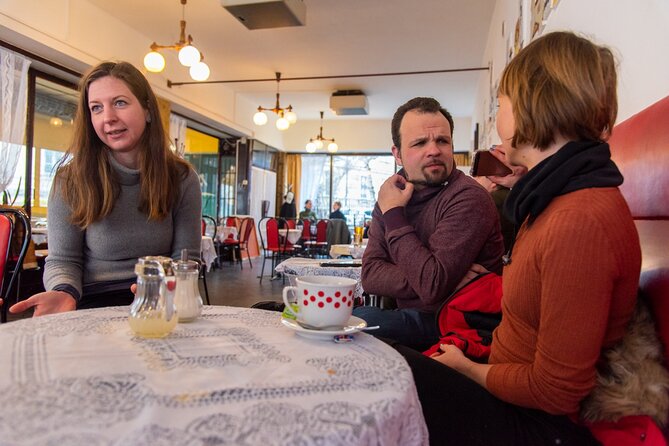
Hungary’s recent story is best understood through a frank conversation, not a quick bus tour. At Bambi Café, a place that has changed little since the 1970s, you spend 90 minutes discussing the move from Communism to democracy and the rise of Hungary’s illiberal democracy with a local host.
I like the small six-person limit, which gives you room to ask direct questions. I also like the flexible format: Daniel or Raymond can give you a structured introduction, then follow your interests into politics, economics, history, or daily life. The one drawback is clear: this is a conversation, not a sightseeing tour, so it may feel too political or abstract if you want monuments and photographs.
Key points to know before booking

- Bambi Café since the 1970s: Meet at a cult Budapest café that has changed very little over the decades.
- Daniel or Raymond as your host: The discussion is led by a local guide who shares personal views as well as background information.
- Hungary after Communism: The opening section focuses on the last 30 years, including the shift to democracy and later political changes.
- No-taboo questions: You can ask about controversial politics, the economy, Hungary’s past, and ideas for the future.
- Only six participants: The small group makes a serious exchange possible rather than a one-way lecture.
- A focused 90 minutes: The experience begins at 2:00 pm and ends back at Bambi Café.
Why this conversation belongs in your Budapest plans
Budapest is easy to admire at street level. You can walk beside the Danube, admire grand buildings, and eat well without learning much about the forces shaping modern Hungary. This experience takes a different route. It asks you to sit down and talk about how the country became what it is today.
That matters because Hungary’s current politics cannot be separated from its 20th-century past. The conversation begins with the transition from Communism to democracy, then moves toward the political and economic changes of the last three decades. You are not simply given dates and names. You are invited to ask how those changes affected real people and how they still influence Hungary.
The format also gives you something a standard city tour rarely can: a chance to test your assumptions. You might arrive with questions about elections, the role of the European Union, economic change, or the meaning of illiberal democracy. You might also be curious about less formal matters, such as how Hungarians view their own country and what they think outsiders misunderstand.
The hosts make clear that honesty is part of the experience. That does not mean every answer will match your own politics. It means you can expect opinions alongside explanation, which is useful when a subject is too current and contested for a neat, packaged answer.
A few more Budapest half-days to weigh up
- Budapest: City Highlights Cruise with Welcome Drink
★ 4.6 · 35,610 reviews - Budapest: Unlimited Prosecco, Beer and Aperol Spritz Cruise
★ 4.8 · 25,310 reviews - Budapest: Széchenyi Spa Day Ticket with Optional Upgrades
★ 4.3 · 23,911 reviews
Bambi Café: a fitting place for modern Hungarian history
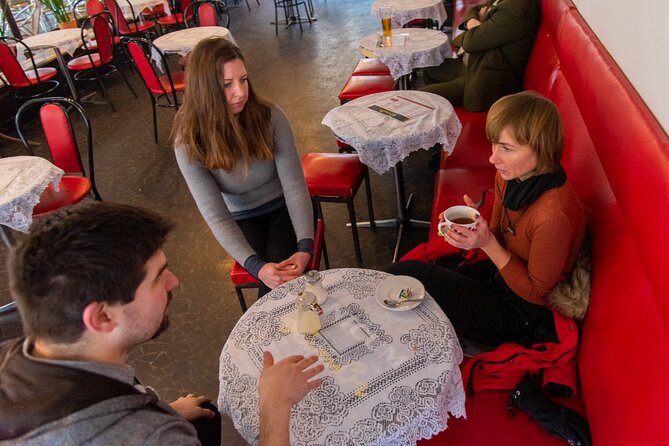
The meeting point is Bambi Café, at Frankel Leó út 2-4 in Budapest’s District II. The café is described as a cult spot that has changed close to none since the 1970s. That setting gives the conversation a useful sense of place.
You are not meeting in a polished conference room or a tourist attraction built to explain Hungary. You are sitting in an older local café with links to the city’s Communist-era past. The surroundings help connect the discussion to the ordinary urban life of another period.
The café itself is the only stop, and admission is free. That may sound modest, but it is central to the experience. The point is not to move you from one sight to the next. The point is to give you time to listen, think, and ask follow-up questions without watching a guide rush toward the next scheduled stop.
The setting also has a practical limitation. Bambi Café may appeal to you precisely because it is old-fashioned and largely unchanged, but this is not designed as a café-hopping experience. You are there for the exchange. Treat the café as the backdrop rather than the main attraction.
The opening: Hungary’s last 30 years in plain terms
The first part usually offers an introduction to Hungary’s modern era. The main focus is the period since the end of Communism, with attention to history, economics, and politics.
This opening is valuable if you know the broad outline of Hungary’s past but struggle to connect it to present-day life. You can use it to understand the shift from a one-party Communist system to democracy, then consider why political developments later took a different direction.
The hosts also address the creation of what is described as illiberal democracy in recent years. That phrase carries political weight, so the chance to ask what it means in the Hungarian context is one of the most useful reasons to book. You can ask for definitions, examples, and the host’s own view rather than relying only on headlines.
Do not expect a university lecture with a fixed syllabus. The information provided promises an introduction, but the shape of the discussion depends on you. If you arrive with no particular questions, the host can guide the first section. If you have already studied modern Hungary, you can use that time to clarify points or challenge the explanation.
The open discussion: bring the questions you normally avoid
After the introduction, the format turns into a conversation. You can ask about controversial politics, Hungary’s uncertain future, the economy, the country’s turbulent past, and ideas for change.
That open design is the experience’s greatest strength. A conventional tour often avoids subjects that might split a group. Here, the difficult subjects are the reason for meeting. You can ask a blunt question, then follow up when the first answer raises another.
The hosts also invite questions about their personal opinions. That is important, but you should remember the distinction between one person’s view and a complete account of Hungary. Daniel or Raymond can offer insight shaped by personal experience and study, yet no single conversation can represent every Hungarian position.
I would prepare three or four questions before you arrive. Think about what you want to understand, not just what you want confirmed. For example, you could ask how the transition from Communism is remembered, how economic change affected everyday life, or what the phrase illiberal democracy means to the host. You can also ask about Hungary’s possible future and what changes might improve the country.
A little preparation will make the 90 minutes more useful. At the same time, do not prepare so much that you turn the meeting into an interview checklist. Leave space for the conversation to move in an unexpected direction.
A completely different kind of day out in Budapest:
- Budapest: Nighttime or Daytime Sightseeing Cruise
★ 4.2 · 21,062 reviews - Budapest: 1-Hour Evening Sightseeing Cruise with Drink
★ 4.5 · 8,330 reviews - Budapest Danube Cruise and Dinner Options, Live Music and Dance
★ 4.5 · 7,428 reviews - Budapest: Historic Cruise with Welcome Drink
★ 4.7 · 6,512 reviews
Daniel and Raymond: two hosts with different voices
The experience is hosted by Budapest Explorers, and Daniel is specifically identified as one of the hosts. The available information also names Raymond. You may therefore meet either guide, so you should expect the tone and emphasis to vary somewhat.
Daniel is described as friendly, informative, and well informed about contemporary Hungary. His discussion style appears suited to people who already know something about modern history and want to understand the present situation more clearly. One participant said the conversation could have continued for several more hours, which suggests that Daniel allows time for an extended exchange rather than rushing through prepared points.
Another account highlights a Hungarian woman with a broad understanding of her own country and the wider world, though her name is not provided. Since the host is not guaranteed in the details available here, book this for the subject and format rather than for a particular personality.
You will get the most from the experience if you are comfortable listening to a point of view that may be personal, political, and open to debate. The hosts promise honesty, but honesty is not the same as neutrality. That can make the conversation more revealing, though it also means you should weigh claims thoughtfully and ask for clarification when needed.
What the six-person limit changes
The maximum group size is six people. That is a major practical advantage for this type of activity.
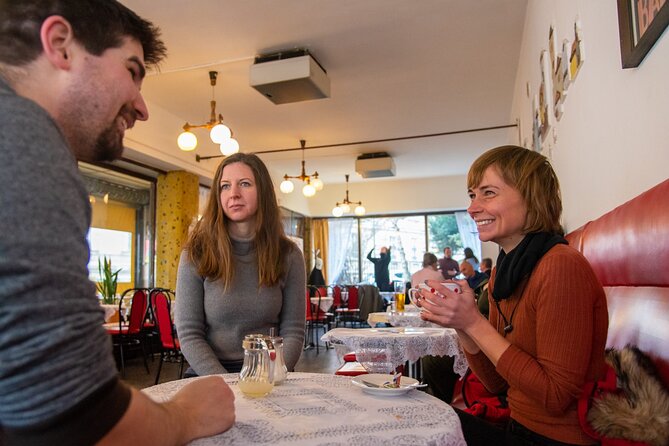
A small group gives you a realistic chance to speak. You can ask a follow-up without holding up a large tour, and the host can adjust the discussion to the interests of the people at the table. If one person wants to discuss economics while another wants to talk about politics, the group can decide where to spend its limited time.
The size also creates a more personal atmosphere. You are not sitting anonymously in the back of a crowd. Your own questions help shape the afternoon, and you will hear the questions other participants bring with them.
There is a trade-off. With only 90 minutes, a group of six can cover a great deal, but it cannot cover everything. If several people arrive with long lists of questions, some topics may receive only a short answer. The best approach is to listen carefully, choose your follow-ups, and accept that the conversation will have limits.
Is $40.52 a fair price?
At $40.52 per person, this costs more than a basic café visit and less than many full sightseeing tours. The value depends on what you want from Budapest.
You are not paying for entrance fees, transport, or a long list of attractions. Bambi Café has free admission, and the activity remains at the meeting point. The price pays mainly for access to a hosted, small-group discussion that would be hard to arrange on your own.
That makes it a good value if you care about modern political life, recent history, and personal interpretation. A private conversation with a local person can help you make sense of what you see elsewhere in the city. It may also help you ask better questions during the rest of your trip.
The value is weaker if you measure tours by the number of sights visited. You will not see Parliament, the Castle District, or the Danube as part of this experience. You will spend the entire 90 minutes at one café, and the reward is understanding rather than sightseeing.
For someone who has already visited Budapest or has a basic grasp of Hungarian modern history, the price is easier to justify. For a first-time visitor with only one afternoon in the city, you may prefer a standard walking tour before choosing this more focused discussion.
Timing, meeting point, and practical details
The activity begins at 2:00 pm and ends back at Bambi Café after approximately 90 minutes. Since there is no travel between stops, you do not need to budget time for a coach, bus, or walking route during the experience.
Bambi Café is near public transportation, which makes the meeting point reasonably practical. The exact transport route is not specified, so check your own route before setting out. Arriving with enough time to find Frankel Leó út 2-4 will help you begin calmly, especially if you have prepared several questions.
A mobile ticket is provided, and confirmation is received when you book. Service animals are allowed, and most people can participate. The small group size is fixed at a maximum of six.
You can cancel for a full refund if you do so at least 24 hours before the 2:00 pm start time. Changes or cancellations made inside that 24-hour window are not accepted for a refund, and the cut-off uses Budapest local time.
Who will enjoy this experience most?
I would choose this conversation for a curious, engaged visitor who wants more than the usual account of Budapest’s monuments. It is especially suitable if you have already read a little about Hungary or visited the city before.
It also suits people who enjoy asking questions and hearing personal opinions. If you like political discussion, recent history, economics, or social change, you will have plenty to work with.
This is less suitable for young children or anyone hoping for a relaxed sightseeing stop with constant visual activity. The supplied details say most people can participate, but the format depends on sitting, listening, and taking part in a serious conversation. If you dislike political subjects, the no-taboo approach may feel uncomfortable.
You should also consider your language needs before booking. The provided information does not specify the language of the conversation, so confirm that point if it matters to you.
How to prepare for a better conversation
Start by deciding what you want to know about present-day Hungary. A broad question such as how the country changed after Communism can lead to a useful discussion, but specific follow-ups will usually produce more practical answers.
You might ask:
- How is the transition from Communism remembered today?
- What does illiberal democracy mean in daily political life?
- How have economic changes affected ordinary people?
- What does Hungary’s uncertain future look like from a local point of view?
- What ideas for change seem realistic?
You do not need a long reading list. Bring an open mind, listen for distinctions, and ask when a term seems unclear. The hosts have created the format for honest questions, so you do not need to soften every subject into polite small talk.
Should you book Hungary Today: A No-Taboo Conversation?
Book it if you want a direct discussion of Hungary’s recent past and present, especially if you have already seen the main sights or want context beyond them. The combination of Bambi Café, a maximum of six people, and an open question period gives the experience a clear purpose.
I would be cautious if you want a traditional tour, a packed itinerary, or a light afternoon activity. This is one café, one conversation, and a subject that can be politically charged.
For the right person, the $40.52 price buys access to a kind of exchange that is difficult to find during ordinary sightseeing. Arrive with a few honest questions, accept that the answers will reflect the host’s opinions, and you should leave with a clearer sense of how modern Hungary is discussed by people who live there.
FAQ
Where does the experience begin?
It begins at Bambi Café, Budapest, Frankel Leó út 2-4, 1027 Hungary.
What time does the conversation start?
The start time is 2:00 pm.
How long does the experience last?
It lasts approximately 1 hour and 30 minutes.
How many people can join?
The activity has a maximum of six participants.
What topics can I ask about?
You can ask about Hungary’s transition from Communism to democracy, illiberal democracy, politics, economics, the country’s past and future, personal opinions, and ideas for change.
Can I cancel for a full refund?
Yes. You must cancel at least 24 hours before the local start time for a full refund. Cancellations or changes made less than 24 hours before the start time are not accepted for a refund.
Recently added around Budapest
- Budapest: Private Walking Tour with a Local Guide★ 3.6 · 6 reviews
- From Budapest: Guided Tour of Eger with Wine Tasting★ 4.5 · 6 reviews
- Budapest: City Bike Tour with Coffee Stop★ 5.0 · 37 reviews
- Budapest: Danube River Views Bike Ride★ 4.8 · 23 reviews
- Budapest: Vacation Photographer to collect great memories★ 5.0 · 49 reviews
- Walk to recent and aged spiritual sanctuaries near Budapest★ 5.0 · 5 reviews
- Trash Art Museum: Hungary’s First Scrap Metal Exhibition★ 4.3 · 72 reviews
- Budapest: Multilingual Highlights Tour★ 4.8 · 89 reviews
Budapest Tours, compared.


Unlimited Prosecco, Beer and Aperol Spritz Cruise
Read our review →
Széchenyi Spa Day Ticket with Optional Upgrades
Read our review →


Budapest Danube Cruise and Dinner Options, Live Music and Dance
Read our review →