

Reviewed · ART NOUVEAU TOURS
Art Nouveau Treasures of Budapest – Exclusive Private Tour
Budapest saves one of its best Art Nouveau surprises for the end: a visit to a private, century-old apartment with an original stained-glass window by Miksa Róth, Hungary’s great master of decorative glass. You also get the city’s grand public examples, including Gellért Baths and Ödön Lechner’s exuberant Postal Savings Bank.
I like the private format, which lets art historian Miklós adjust the pace and explain details that are easy to miss on your own. I also like the mix of famous buildings and normally closed interiors. The main drawback is that much of the tour takes place outdoors, and public transportation tickets are not included.
Key things to know before you book
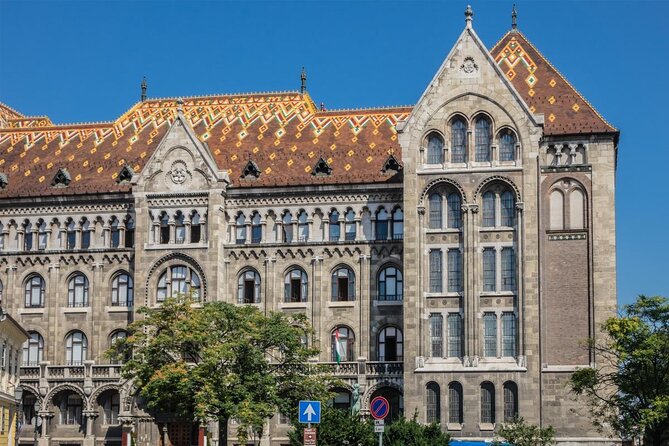
- Miksa Róth’s private stained glass: The tour ends inside a private apartment, where you can see a genuine Róth window in its original residential setting.
- Ödön Lechner’s tilework: The Postal Savings Bank on Hold utca is a colorful display of Hungarian folk motifs and Secessionist design.
- Gellért Baths from the outside: You see the historic bath and hotel as an architectural work of art, but admission to bathe is not part of the tour.
- A walking tour with public transport: No private vehicle is provided, so expect city walking plus any needed transit.
- Flexible timing: The start time can be customized, and hotel pickup in Budapest may be arranged.
- Best for design lovers: The focus is architecture, stained glass, ornament, and the way Art Nouveau shaped Budapest.
Why this Budapest Art Nouveau tour is different
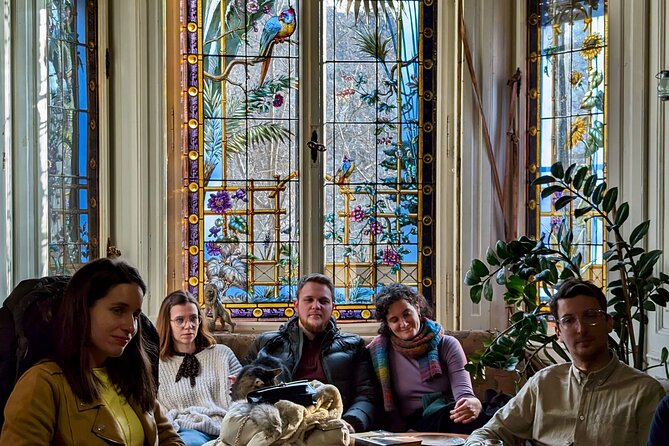
Budapest has plenty of grand buildings, but its Art Nouveau is easy to miss if you only follow the standard route around Parliament, the Castle, and St. Stephen’s Basilica. The city’s Secessionist architecture often hides in plain sight, tucked into residential streets or behind the entrance of a hotel, café, bank, or apartment building.
This tour gives those details a clear theme. You are not simply being driven past a series of pretty façades. You walk from site to site while an art historian explains the design language, the role of folk motifs, and the work of Hungarian artists such as Ödön Lechner and Miksa Róth.
The experience is led by Miklós, the guide associated with Fungarian. His approach is especially useful if you want more than dates and building names. He brings the subject back to the city itself, explaining how Art Nouveau became part of Budapest’s identity and how the style appeared in both monumental public buildings and ordinary residential spaces.
The tour has a strong personal touch. The final apartment visit is not a standard museum stop with a large collection. It is one old building and one important work of glass. That makes the ending feel more intimate, though it also means the experience depends on your interest in close-looking rather than checking off a long list of sights.
More art nouveau walks in Budapest:
- Private Art Nouveau Tour Budapest
★ 5.0 · 21 reviews - Art Nouveau Tour in Budapest: 3-Hour Private Tour
★ 4.6 · 21 reviews - Budapest Art Nouveau Walking Tour
★ 5.0 · 17 reviews
Starting at Central Market Hall
The tour begins at Central Market Hall, a useful place to meet because it is a major Budapest landmark and easy to locate. The building itself is not simply a starting point. Its structure and decorative details provide a natural introduction to the city’s love of ornament, craft, and colorful architectural surfaces.
You spend about 20 minutes here. Admission is not included, so clarify with the operator exactly how the visit will work if you want to enter beyond the meeting area. The supplied details identify Central Market Hall as the starting point, while the tour description also notes a private apartment at the end. That means you should think of the market as the opening meeting point, not the main architectural focus.
From here, the walk moves toward the Danube and across one of Budapest’s attractive bridges. The route gives you a chance to see the river and the Buda side before reaching the foot of Gellért Hill. This is one of the tour’s better features: the city’s setting becomes part of the experience instead of being treated as background scenery.
The walk is not presented as a strenuous hike, but you should wear comfortable shoes. The tour lasts roughly two and a half to three hours, and the route combines streets, bridge crossings, and public transportation if needed.
Gellért Baths, a functioning work of art
The next major stop is the Gellért Thermal Bath and Swimming Pool, part of the historic Hotel Gellért complex on the western bank of the Danube. You spend about 20 minutes here.
Gellért is useful for understanding how Budapest treated public bathing as both a practical service and an architectural statement. The building is associated with the Secessionist style, the Central European form of Art Nouveau, and its decorative character makes it more than a place to swim.
You will see the exterior and learn how the bath and hotel fit into Budapest’s larger architectural story. Bath admission is free as part of the tour, which means there is no separate entry charge for this brief stop. That does not mean you receive time to use the pools. Bring a swimsuit only if you have other plans to visit the baths later.
This stop also shows the tour’s limits. Twenty minutes is enough for an explanation and an exterior look, but not enough for a full architectural study or a bathing visit. If Gellért is high on your personal list, plan a separate visit.
Crossing Budapest’s first stone bridge
The route continues across Budapest’s first stone bridge, with views toward the Hungarian Royal Palace. The supplied description does not name the bridge, but the purpose of this section is clear: you get a scenic transition between the Buda and Pest sides of the city.
This is a good moment to look beyond the buildings. Budapest’s architecture makes more sense when you see how the Danube divides and connects the city. The bridge crossing adds a little sightseeing variety to a tour that could otherwise feel like a sequence of façades.
You should also expect normal city conditions here: pedestrians, traffic, weather, and occasional pauses while the group stays together. Because this is a private tour, you can ask Miklós to slow down for photographs or explain a feature that catches your eye.
A few more Budapest half-days to weigh up
- Budapest: City Highlights Cruise with Welcome Drink
★ 4.6 · 35,610 reviews - Budapest: Unlimited Prosecco, Beer and Aperol Spritz Cruise
★ 4.8 · 25,310 reviews - Budapest: Széchenyi Spa Day Ticket with Optional Upgrades
★ 4.3 · 23,911 reviews - Budapest: Nighttime or Daytime Sightseeing Cruise
★ 4.2 · 21,062 reviews
Ödön Lechner’s Postal Savings Bank
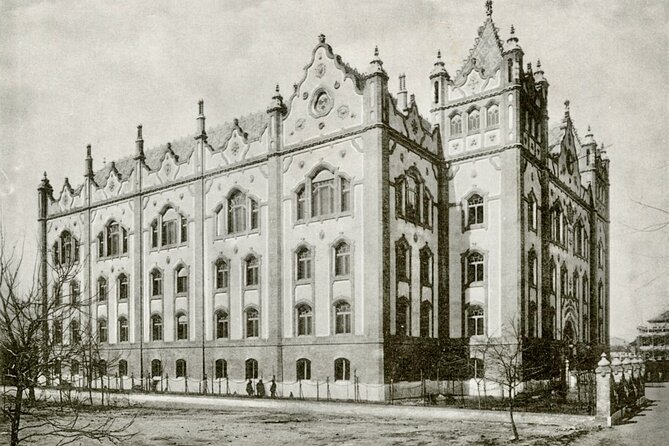
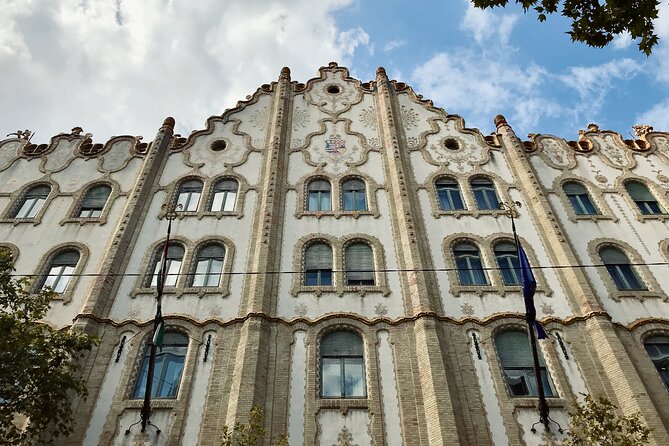
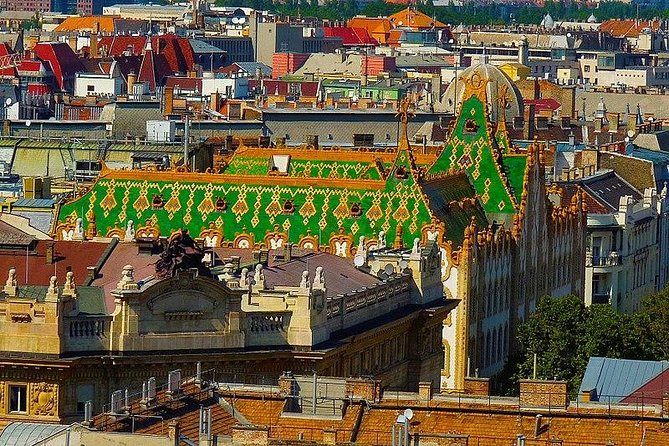
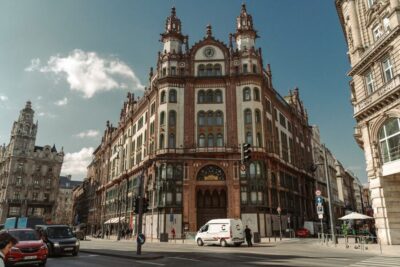
The Postal Savings Bank on Hold utca is the architectural centerpiece of the tour. It was designed by Ödön Lechner in 1901 and is considered one of Budapest’s finest examples of Secessionist design.
Lechner did not treat ornament as a thin layer added to a plain building. He made decoration part of the architecture itself. Here, colorful ceramic tiles and folk-inspired motifs create a façade that feels unmistakably Hungarian. The design is playful and bold, far removed from the restrained stone fronts found elsewhere in the city.
You spend about 20 minutes at this stop. Admission is listed as free. The stop is especially valuable with a guide because the details are easy to overlook when you are standing across the street. Look closely at the roofline, tile patterns, and the way traditional motifs are adapted for a modern building.
The supplied route also includes a stop labeled Nemzeti Bank, but its description repeats the Postal Savings Bank on Hold utca. Treat these as a description overlap rather than two clearly separate architectural visits. If the National Bank building is important to you, ask Miklós before the tour begins exactly which exterior you will see.
This is also where the tour’s art history focus earns its keep. A general city guide might tell you that the building is unusual. An art historian can help you understand why it looks unusual and how Lechner’s approach differs from French, Belgian, or Austrian Art Nouveau.
Gutenberg Square and Miksa Róth’s glasswork
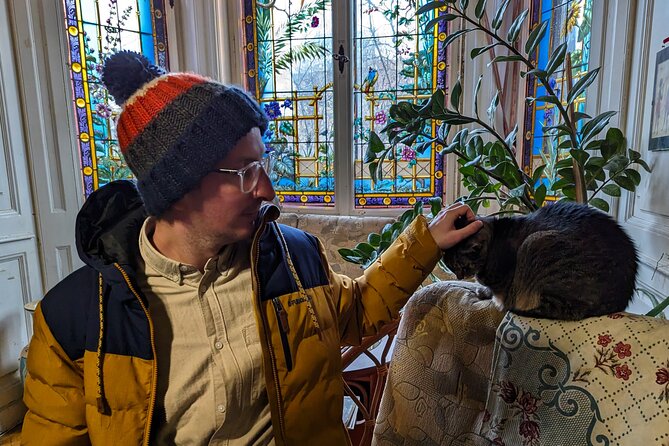
Gutenberg Square brings a different scale and mood. The stop lasts about 15 minutes and focuses on a historic building in Budapest’s Palace District, an area associated with grand nineteenth-century residences and public buildings.
Here, the detail to watch is the staircase and its leaded glass attributed to Miksa Róth. The building is described as Art Deco, so this stop also helps show how decorative fashion changed over time. Budapest’s early twentieth-century architecture was not frozen in one style. Art Nouveau and Art Deco can appear close together, with stained glass, geometric detail, and carefully designed interiors linking them.
The staircase matters because it shows how design reached into everyday movement through a building. You are not only looking at a distant façade. You are seeing how light, glass, and ornament shaped an interior space used by residents.
The stop is free, and the short time keeps the tour moving. If you are an especially serious stained-glass enthusiast, you may wish the tour offered more time here. Still, it sets up the final visit very well by showing how Róth’s work could function as part of a building rather than as an isolated museum object.
The private apartment and the Róth window
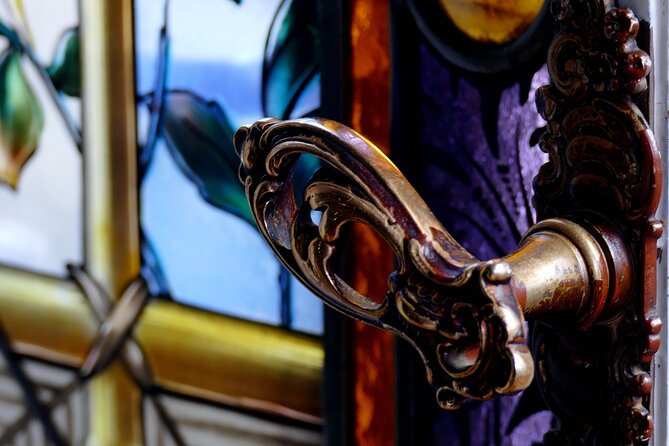
The most unusual part of the experience comes at the end, in a private apartment in a century-old building. You have an exclusive chance to see an original stained-glass window by Miksa Róth.
This is not a public museum display. It is a work encountered in a residential setting, which gives you a better sense of how Art Nouveau operated in private life. The design was not limited to palaces and banks. It could also appear in an apartment stairway or interior room, bringing color and craftsmanship into daily life.
The apartment is described as the tour’s final stop, in the Rákóczi tér area. The tour page also describes the ending as a private apartment rather than a standard public attraction. That is worth keeping in mind when booking: access is special, but the setting is intimate and dependent on the owner’s arrangements.
Miklós connects this window to Róth’s wider career. Róth’s work can also be found in major Budapest buildings, including the Parliament and other public structures that may not always be open for close inspection. Here you get to see his craft at a more human scale.
For me, this ending gives the tour a purpose beyond a walk through attractive streets. You finish with one specific object to remember, not just a collection of façades. If you are mainly interested in grand interiors, public access, or a large number of buildings, the apartment may feel modest. If you appreciate craftsmanship and private details, it is likely to be the highlight.
How much walking and public transport to expect
This is a walking tour with public transportation, not a private car tour. Pickup may be arranged from your Budapest hotel or from a central meeting point, but the tour itself does not include private transportation.
The overall duration is about two hours and 30 minutes to three hours. The route includes Central Market Hall, a bridge crossing, Gellért Baths, the Hold utca buildings, Gutenberg Square, and the private apartment. Some stops are brief, so the pace is steady rather than leisurely.
Public transportation tickets are not included. Carry a ticket or be ready to purchase one if the route requires transit. Comfortable shoes are the sensible choice, and an umbrella or light rain layer is useful since several stops take place outside.
The start time is flexible on request. That is helpful if you are working around a museum reservation, an arrival train, or a planned bath visit. Ask for the preferred time when booking rather than assuming every departure is fixed.
Price and value for a private group
The cost is $261.67 for a group of up to five people. At the full group size, that works out to about $52.33 per person. For a couple, the per-person cost is much higher, but you are paying for a private art historian guide, a custom start time, and access to a private apartment that you would not ordinarily enter.
The price makes the most sense for a small group with a real interest in architecture, decorative arts, or Budapest’s Secessionist movement. It is less compelling if you only want a broad introduction to the city or a fast list of major sights.
I would also compare the tour’s length with your expectations. You are paying for interpretation and access, not a full-day architecture survey. One guest wanted the full three hours devoted to buildings and preferred to skip a refreshment break. That is useful advice if your priority is maximum architectural content. You can ask whether the break can be omitted or whether an extension is possible.
The tour is booked, on average, well ahead of time, about 63 days in advance. That suggests planning early if your schedule is fixed, especially for a private experience with a flexible guide.
Who will enjoy this tour most
This experience suits you if you:
- Already like Art Nouveau, Secessionist design, or stained glass.
- Want context from an art historian rather than a general sightseeing talk.
- Prefer a private tour where you can ask questions and set the pace.
- Enjoy seeing interiors that are not part of the normal public route.
- Want to combine architecture with bridge views and city walking.
- Are happy with a focused tour of about three hours.
It may not suit you as well if you want to spend a long time inside Gellért Baths, visit many museums, avoid public transportation, or see every major Art Nouveau building in Budapest. The route offers a selected group of places, not a complete catalogue.
The tour is offered in English. Confirmation is provided when you book, mobile tickets are accepted, service animals are allowed, and most people can participate. Free cancellation is available up to 24 hours before the local start time. Changes or cancellations made inside that window are not refunded.
Should you book it?
Book this tour if Budapest’s decorative architecture is one of your reasons for visiting. The combination of Lechner’s tilework, Gellért’s bath architecture, Róth’s stained glass, and a private apartment gives you access to parts of the city that are easy to miss alone.
I would especially recommend it to a small group of up to five people. The price becomes much better at full capacity, and a private guide makes sense when the subject is detailed and visual. If your interest is casual, choose a broader Budapest walking tour instead. If you want to understand how Art Nouveau shaped both public buildings and private homes, this is a strong, specialized choice.
FAQ
How long does the Art Nouveau Treasures of Budapest tour last?
The tour lasts approximately two hours and 30 minutes to three hours.
Where does the tour start?
The stated starting point is Central Market Hall in Budapest, at 1093 Hungary. Hotel pickup may also be arranged within Budapest, or you can agree on a central meeting point.
Where does the tour end?
The tour ends in a private, century-old apartment in the Rákóczi tér area of Budapest.
Is the tour private?
Yes. Only your group participates, with a maximum group size of five people.
Is the tour offered in English?
Yes. The tour is offered in English.
Is an art historian included?
Yes. The experience includes a professional art historian guide, along with a local and professional guide.
Does the tour include private transportation?
No. The tour is conducted on foot with public transportation as needed. Public transportation tickets are not included.
Is admission to Gellért Thermal Bath included?
The stop at Gellért Thermal Bath has no separate admission charge as part of the tour. The tour does not include time to use the pools.
Is the Postal Savings Bank included?
Yes. The route includes the Postal Savings Bank on Hold utca, designed by Ödön Lechner in 1901. The exterior is known for colorful tiles and folk motifs.
Can I cancel the tour for a refund?
Yes. You can cancel up to 24 hours before the experience starts for a full refund. Cancellations or changes made less than 24 hours before the start time are not refunded.
Recently added around Budapest
- Budapest: Private Walking Tour with a Local Guide★ 3.6 · 6 reviews
- From Budapest: Guided Tour of Eger with Wine Tasting★ 4.5 · 6 reviews
- Budapest: City Bike Tour with Coffee Stop★ 5.0 · 37 reviews
- Budapest: Danube River Views Bike Ride★ 4.8 · 23 reviews
- Budapest: Vacation Photographer to collect great memories★ 5.0 · 49 reviews
- Walk to recent and aged spiritual sanctuaries near Budapest★ 5.0 · 5 reviews
- True Crime Walking Tour in the Buda Castle district★ 5.0 · 26 reviews
- Trash Art Museum: Hungary’s First Scrap Metal Exhibition★ 4.3 · 72 reviews
Art Nouveau Tours, compared.
Art Nouveau Tour in Budapest: 3-Hour Private Tour
Read our review →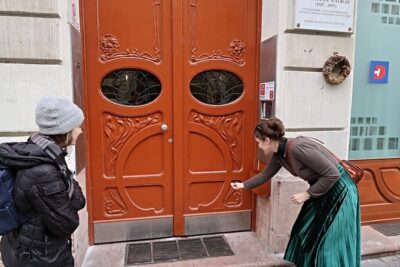
Browse the lists this tour appears in