

Reviewed · BUDA CASTLE TOURS
Buda Castle Private Walking Tour: A Kingdom of Many Nations
Buda Castle Hill is less a single castle than a whole historic district, and that is the key to this tour. You walk narrow cobbled streets between the royal palace, Matthias Church, Sándor Palace, Fisherman’s Bastion, and Vienna Gate while an historian explains how Hungarian kings, Ottoman rulers, and Habsburg emperors reshaped the hill.
I like the private format, which gives you room to ask questions instead of following a large group. I also like the focus on historical context, especially the way the guide explains how the palace changed from royal home to military site, government building, and modern cultural space. Guides named Kata and Julia have received especially warm praise for making the past feel clear and relevant.
The main drawback is the name. If you expect to enter a preserved medieval royal castle, you may be disappointed. Much of the palace was rebuilt after wartime destruction, and admission to Matthias Church and Fisherman’s Bastion is not included in the $397.36 group price.
Key things to know before booking
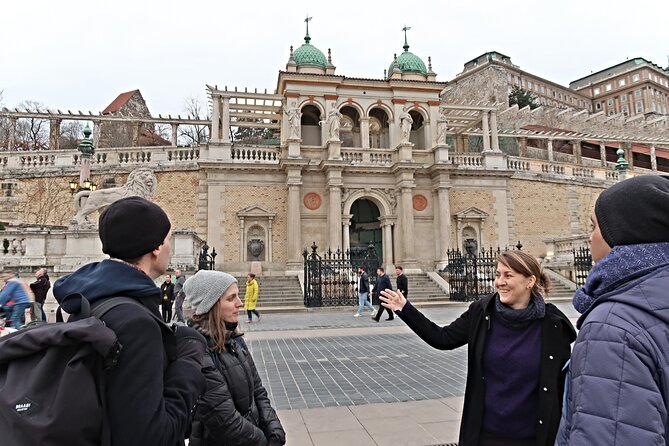
- The tour covers the full Castle Hill story: You visit the royal palace area, Sándor Palace, Matthias Church, Fisherman’s Bastion, and Vienna Gate.
- Your guide is the main attraction: An English-speaking historian leads the walk, with Kata and Julia singled out for clear, detailed explanations.
- It is private, not a standard group walk: The listed price covers one group of up to 10 people, though booking information also refers to a maximum of 8 per booking.
- The palace is a rebuilt complex: Buda Castle has been altered, damaged, and rebuilt many times, so do not expect one untouched medieval structure.
- Two important entry fees are extra: Matthias Church and Fisherman’s Bastion require separate admission tickets.
- You finish with wide views: Vienna Gate looks toward Óbuda, while Fisherman’s Bastion opens across the Danube toward Pest, Margaret Island, and Gellért Hill.
Why Castle Hill works best with a historian
Buda Castle Hill is easy to admire and surprisingly easy to misunderstand. You can see grand buildings, colored roof tiles, stone towers, and Danube views on your own. What you cannot easily see is the sequence of power behind them.
The hill began as a fortified royal center after King Béla IV built here around 1250, following the destructive Mongol invasion. Later, King Matthias turned the court into one of Europe’s leading Renaissance centers in the late 15th century. Ottoman pashas then ruled Hungary for more than 150 years, followed by Habsburg emperors and the modern Hungarian state.
That is a lot of history for a compact hilltop. I like this tour because the guide’s job is not simply to identify buildings. The guide connects each building to a change in government, religion, architecture, or daily life. The strongest praise has focused on subtle details and historical background, which is exactly what this part of Budapest needs.
A private guide also helps you set the pace. You can ask why the palace looks so different from a medieval fortress, or pause longer at Matthias Church and Fisherman’s Bastion. If you already know Hungarian history, you can ask for finer points. If you are new to it, the guide can build the story from the beginning.
More ways to see Buda Castle:
- Budapest: Buda Castle Cave Tour
★ 4.7 · 5,677 reviews - Budapest: Buda Castle District Vampires and Myths Night Tour
★ 4.6 · 3,830 reviews - Budapest: Buda Castle Walk with Saint Stephen’s Hall
★ 4.5 · 3,012 reviews
Starting near Bécsi kapu tér
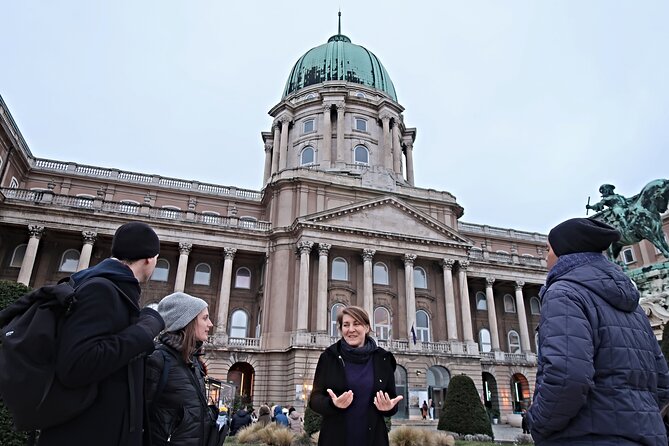
Unless hotel pickup has been arranged, meet your guide 15 minutes before the start at Bálthazár, a hotel with a café at Országház utca 31. The meeting point is about 50 meters from the first bus stop on Castle Hill, near Bécsi kapu tér.
That location puts you close to the northern end of the hill, while the walk begins around the palace area and later ends at Vienna Gate. You should arrive early enough to find the café and meet your guide without rushing. Pickup is offered, but it must be arranged rather than assumed.
The tour lasts about three hours and is offered in the morning or afternoon. That choice matters. Morning can give you a cooler start and more time afterward for museums or the city center. An afternoon departure may fit better with a morning visit to the Parliament area, though the tour’s exact light and atmosphere will depend on the season.
This is a walking tour on Castle Hill, with narrow streets and cobbled surfaces. The information says most people can participate, but it does not promise a fully step-free route. If you have mobility concerns, ask about the route when arranging the tour.
The royal palace and the problem with the name Buda Castle
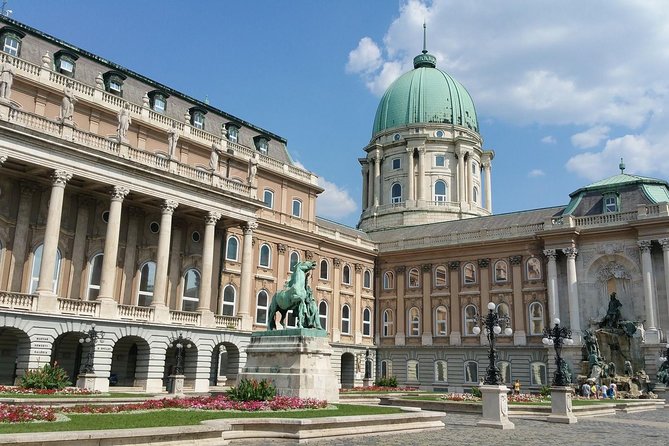
The first major focus is the great palace at the southern end of Castle Hill. It is massive, imposing, and visually dominant, but the most useful part of the visit is understanding what happened to it over time.
King Béla IV established a fortress here around 1250. In the Renaissance period, King Matthias expanded the site into a celebrated royal court. Ottoman rulers later used the hill during their long control of Hungary, and Habsburg monarchs reshaped it again. The palace was rebuilt, extended, altered, burned, and reconstructed more than once.
Its current appearance is largely an eclectic postwar reconstruction. That fact is important because the name Buda Castle can create a misleading picture. You are not walking into one perfectly preserved medieval residence. You are exploring a palace complex whose form reflects many periods, including major rebuilding after World War II.
One piece of the tour specifically examines the building’s changing function. That is a smart focus. A palace can be a royal home, a seat of government, a military position, a ruin, and a symbol of national identity at different moments. The guide helps you read those changes instead of judging the building only by its exterior.
A short 15-minute palace segment is listed separately within the longer Castle Hill visit. Expect this to be an outdoor historical explanation rather than a full palace interior tour, since no palace admission is included.
Sándor Palace and Hungary’s modern state

A brief stop at Sándor Palace shifts the story from kings and empires to present-day government. The Neoclassical building dates to 1806 and was commissioned by Count Vincent Sándor, an aristocrat and philosopher of the Austro-Hungarian Empire.
Since 2003, it has served as the official residence of Hungary’s president and the seat of the Office of the President. The stop lasts about five minutes, so it is not a lengthy architectural visit. Its value comes from the contrast with the royal palace nearby.
Here, the guide can show you how Castle Hill remains a working political center rather than only a historic quarter. The building also gives the walk a clear bridge between imperial-era Budapest and the modern Hungarian republic.
More walking tours in Budapest:
- Big Bus Budapest Hop-On Hop-Off Bus and Walking Tour
★ 3.5 · 2,206 reviews - Budapest: Buda Castle District Walking Tour
★ 4.6 · 2,108 reviews - Budapest City Landmarks Walking Tour in 2 Hours
★ 5.0 · 2,048 reviews - 3-Hour Orientation Walking Tour of Buda and Pest
★ 4.8 · 1,834 reviews
Matthias Church: a Gothic look with a later history
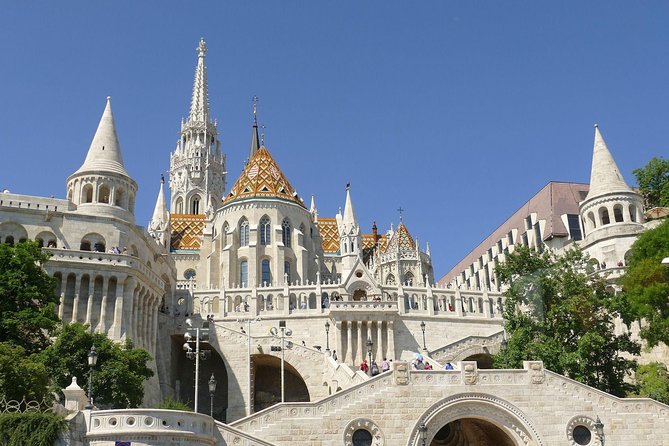
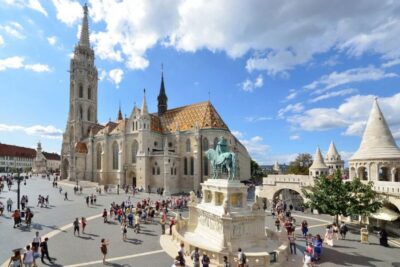
Matthias Church is one of the visual highlights of the hill. Its patterned roof catches your eye before you reach the entrance, and its interior is described as richly decorated and strikingly beautiful.
The church you see today is a highly executed Neo-Gothic reconstruction from the end of the 19th century. That detail is worth remembering. Like the palace, it is not a simple untouched survivor from the Middle Ages. It is a later architectural interpretation of Hungary’s medieval past.
The church has a strong connection to King Matthias in its name and setting, but the building’s present form reflects restoration and reconstruction. A good guide can help you separate the medieval associations from the 19th-century design choices.
The visit lasts about 20 minutes. Admission is not included, so you will need to pay separately if you want to enter. If you prefer to keep the tour cost down, you can still appreciate the exterior and listen to the guide’s explanation, but the interior is an important part of the experience.
I would prioritize the church ticket if you care about architecture, color, and decorative detail. The short visit means you should not expect a slow, museum-style examination of every feature. It is a focused stop within a larger historical walk.
Fisherman’s Bastion and the best city views
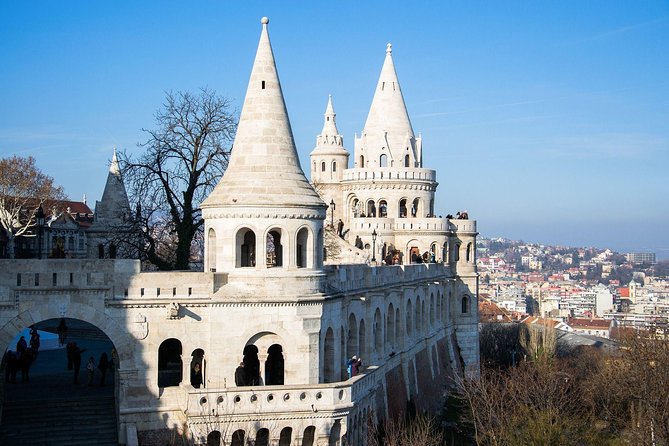
Fisherman’s Bastion is where the tour becomes especially scenic. Its towers and terraces were designed in Neo-Gothic and Neo-Romanesque styles between 1895 and 1902. The seven towers represent the seven Magyar tribes traditionally associated with the settlement of the Carpathian Basin at the end of the ninth century.
The structure looks defensive, but it is largely an architectural fantasy rather than a working medieval fortress. That makes it a useful companion to Matthias Church. Both buildings show how late 19th-century Budapest presented national history through dramatic architecture.
From the terrace, you can look across the Danube toward Pest, Margaret Island, and Gellért Hill. These views are among the clearest reasons to include Castle Hill in a Budapest visit, and the guide adds meaning to the scene by pointing out how the two halves of the city relate to one another.
Admission to Fisherman’s Bastion is not included. Since the site includes terraces and viewing areas, ask your guide which parts require a ticket and factor that extra cost into your plan. The visit is listed at about 20 minutes, enough for the main explanation and photographs, but not a long, unhurried stay at every lookout.
Vienna Gate and the walk toward Óbuda
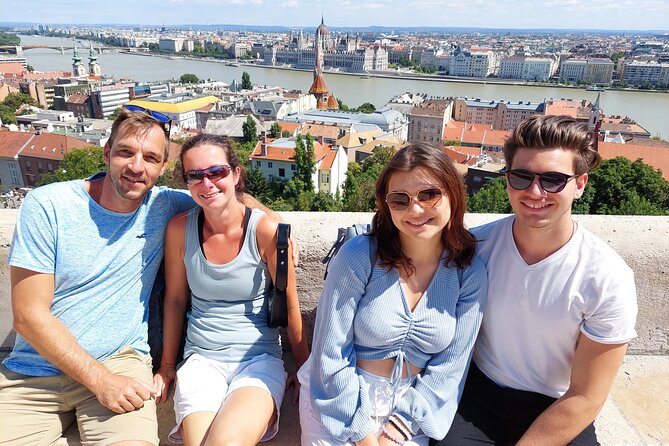
The tour ends at Vienna Gate, on the northern side of Castle Hill. From here, you can see toward Óbuda, or Old Buda, where the Romans founded the city known as Aquincum.
This is a thoughtful ending because it widens the story again. The walk begins with the medieval royal center and ends by pointing toward the Roman roots of the city. You finish not only with views but with a clearer sense that Budapest grew from several older settlements and political centers.
The end point is also practical. Since the tour does not return you to the original meeting point, plan your next move before you arrive. The supplied details identify Budapest as the end location but do not specify onward transportation arrangements.
What the private price gets you
The price is $397.36 per group, with the experience described as accommodating up to 10 people. Another booking detail gives a maximum of 8 people per booking, while the overall activity limit is 10 travelers. Because those figures do not match perfectly, confirm the permitted group size before paying, especially if you have a large family or party.
For a full group, the price can be reasonable for a three-hour private walk with a professional historian. Split among 8 people, it is roughly $50 per person. Split among 10, it is about $40 per person. For two people, the cost becomes much harder to justify unless personal attention and historical depth matter more to you than keeping the budget low.
The price does not include food, drinks, Matthias Church admission, or Fisherman’s Bastion admission. You should treat the advertised amount as the guide fee and group experience cost, not the complete cost of the afternoon.
I see the best value for families, several couples traveling together, or a small group with a serious interest in Budapest’s past. A private guide can answer questions that a standard group walk may not have time for. Solo visitors and couples may prefer a less expensive shared walk unless they specifically want private commentary.
Who will enjoy this walk most
You will get the most from this tour if you like buildings with complicated pasts. The palace is not a tidy medieval relic, Matthias Church is a later reconstruction, and Fisherman’s Bastion is a modern romantic vision of the past. The guide’s historical explanation makes those distinctions worthwhile.
This is also a good choice if you want to ask questions. The private setup gives you more control over the conversation, and the strongest guide feedback has focused on detailed background and small historical points. Kata and Julia are names to request if the provider can confirm guide availability, though a specific guide cannot be guaranteed from the supplied information.
You may want another type of visit if your main goal is entering museums or spending hours inside the palace. The route is primarily an outdoor walking experience, and the palace discussion is centered on its history and changing function rather than an included interior visit.
The tour suits people who want structure but not a rigid schedule. You see the essential sites in three hours, then have the rest of the day for the Danube, Pest, or another museum.
Booking, cancellation, and practical details
Confirmation is sent within 48 hours of booking, subject to availability. The experience is usually booked about 12 days in advance, so arranging it early makes sense if you want a morning or afternoon choice.
Free cancellation is available up to 24 hours before the start time. Cancellations or changes made less than 24 hours before the start are not refunded or accepted, and the cut-off uses Budapest local time.
The tour is conducted in English and includes a mobile ticket. Public transportation is nearby, and hotel pickup may be arranged. Food and drinks are not included, so plan those separately rather than expecting a café stop to be part of the walk.
Should you book the Buda Castle private walking tour?
Book it if you want Castle Hill explained by an historian rather than simply photographed. The tour brings together the royal palace, Hungarian kings, Ottoman rule, Habsburg power, modern government, Neo-Gothic design, and Roman Óbuda in one clear three-hour route.
I would especially recommend it for a group of four or more, where the private price becomes easier to share. Ask about the group-size discrepancy, confirm whether hotel pickup is arranged, and budget extra for Matthias Church and Fisherman’s Bastion.
Skip it if you want a low-cost walk, a long palace interior visit, or a perfectly preserved medieval castle. For everyone else, the combination of private attention, strong historical explanation, and excellent viewpoints makes this a practical way to understand Budapest’s most layered hill.
FAQ
How long does the Buda Castle private walking tour last?
The tour lasts approximately three hours.
What language is the tour offered in?
The tour is offered in English.
Is the tour private?
Yes. It includes a private guide for your group.
How many people can join the tour?
The activity is listed for groups of up to 10 people. The booking details also mention a maximum of 8 people per booking, so confirm the allowed size if your party is large.
Where does the tour start?
Unless hotel pickup has been arranged, meet at Bálthazár, Országház utca 31, 1014 Budapest, about 50 meters from the first bus stop on Castle Hill near Bécsi kapu tér.
Where does the tour end?
The walk ends at Vienna Gate in Budapest.
Are admission tickets included?
No. Admission to Matthias Church and Fisherman’s Bastion is not included. Food and drinks are also excluded unless specified.
Can I choose a morning or afternoon departure?
Yes. The tour offers a choice of morning or afternoon departure.
Can I cancel for a full refund?
Yes, if you cancel at least 24 hours before the experience starts. Cancellations or changes made less than 24 hours before the start are not accepted for a refund.
Recently added around Budapest
- Budapest: Private Walking Tour with a Local Guide★ 3.6 · 6 reviews
- From Budapest: Guided Tour of Eger with Wine Tasting★ 4.5 · 6 reviews
- Budapest: City Bike Tour with Coffee Stop★ 5.0 · 37 reviews
- Budapest: Danube River Views Bike Ride★ 4.8 · 23 reviews
- Budapest: Vacation Photographer to collect great memories★ 5.0 · 49 reviews
- Walk to recent and aged spiritual sanctuaries near Budapest★ 5.0 · 5 reviews
- True Crime Walking Tour in the Buda Castle district★ 5.0 · 26 reviews
- Trash Art Museum: Hungary’s First Scrap Metal Exhibition★ 4.3 · 72 reviews
Buda Castle Tours, compared.

Buda Castle District Vampires and Myths Night Tour
Read our review →

Buda Castle District Dark History, Legends and Vampire Night Tour
Read our review →
Buda Castle District Walking Tour with a Historian
Read our review →
Browse the lists this tour appears in