
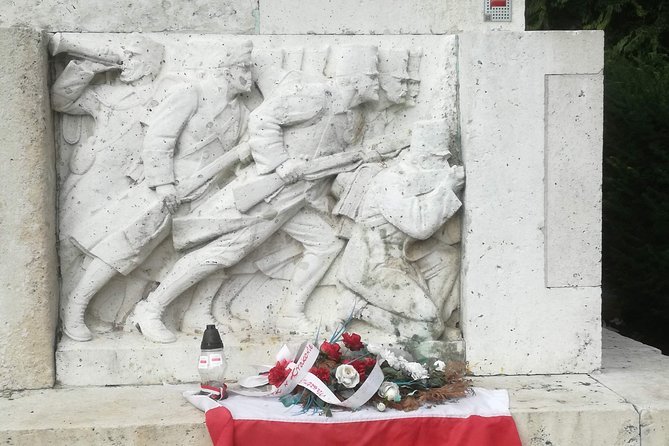
Reviewed · COMMUNIST HISTORY TOURS
Communist Budapest Walking Tour
Budapest’s communist past comes into focus through ordinary places: a coffeehouse with its 1960s interior, a block of flats once prized for its lifts and hot-water comforts, and a broad parade route where workers were expected to march beneath red flags. The tour explains Goulash Communism, Hungary’s bargain of modest private freedoms in return for political obedience.
I like the way the route joins major events to daily life, rather than stopping at monuments. I also like the use of old photographs on an iPad, which helps you see how Stalin-era Budapest differed from the city around you today. The main drawback is that the tour may feel introductory if you already know Hungary’s communist period well.
Key points at a glance
- 1960s coffeehouse: Begin at Bambi Eszpresszó, a cafe that retains its period interior.
- 1956 in the city center: Visit Bem József Square and Kossuth Square, two key locations in the uprising.
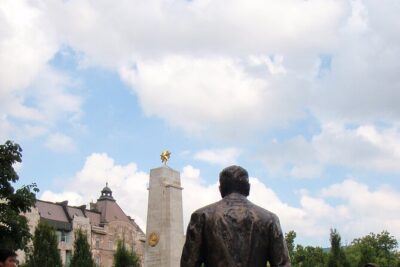
- Cold War symbols: See the American Embassy, Soviet memorial, Ronald Reagan statue, and atomic shelter entrance at Freedom Square.
- Everyday life: Visit 1970s housing blocks and learn why many families welcomed these plain-looking apartments.
- Socialist Realism: See statues of heroic workers, soldiers, and intellectuals near Puskás Stadium.
- Expert-led format: Guides include historians, professors, doctoral students, journalists, art critics, and published authors.
Starting at Bambi Eszpresszó and Bem József Square
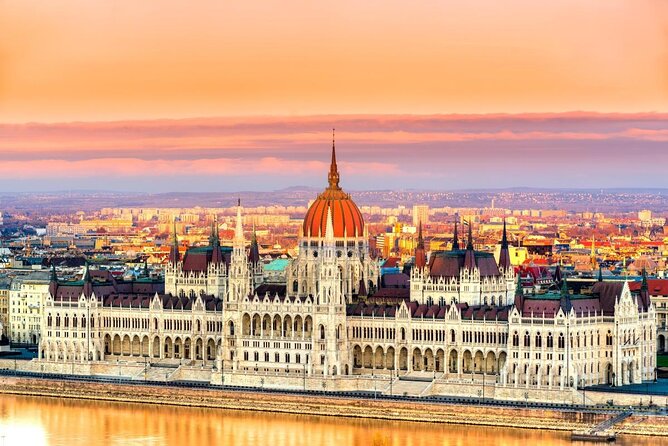
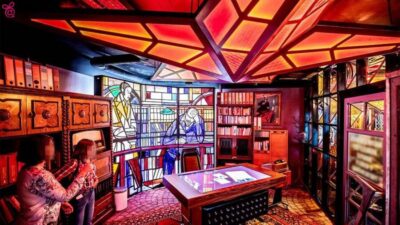
The tour begins at Bambi Eszpresszó, at Frankel Leó út 2/4 in Budapest’s District II. This is more than a simple meeting point. The cafe has kept its original 1960s interior, giving you an immediate sense of the period before the guide starts connecting the room to national politics.
From here, you visit Bem József Square, where the first large demonstration of the 1956 uprising took place. The square helps establish an important point about communist Hungary: resistance was not only an abstract political act. It happened in public streets, among workers, students, and residents who had grown tired of Soviet control and domestic repression.
I like this opening because it begins with a real place and a specific event. You are not asked to absorb a long lecture before seeing anything. Instead, the square gives the guide a clear setting for explaining how the uprising began and why Budapest became the center of a national revolt.
The tour is led in English by a guide with an academic or publishing background. Andras, one guide associated with the experience, has been praised for keeping the pace relaxed and adjusting the route when guests have already seen some of the scheduled sites. That flexibility matters on a private or small-group tour, especially if you have already spent time around Parliament or central Pest.
More communist history tours in Budapest:
- Budapest: Communist History Tour with House of Terror Option
★ 4.8 · 182 reviews - Budapest: 3-Hour Walking Tour About Communism (Small Group)
★ 4.7 · 70 reviews - Communism in Hungary with a Historian
★ 5.0 · 70 reviews
Kossuth Square and the violence of 1956
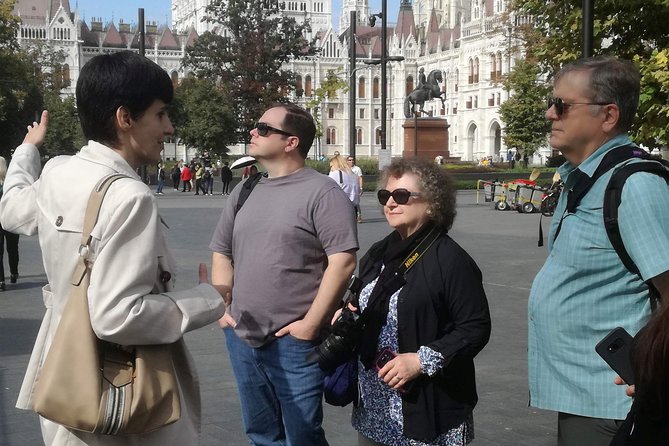
A metro ride takes you toward Kossuth Square, the broad ceremonial space in front of Parliament. This is one of the tour’s most important stops because the square witnessed major political and armed conflict during the 1956 revolution.
Your guide points out monuments connected with those events and explains how the square became a place of confrontation. The setting can feel formal and orderly today, but the tour asks you to picture it during a crisis when the authority of the communist state was being openly challenged.
This section works best if you want political background tied to physical locations. The guide can show you where the events unfolded, then connect them to the larger failure of the 1956 uprising. You should expect historical explanation rather than a museum-style display, so the quality of the experience depends heavily on how much detail your guide provides.
The metro rides are part of the point. Budapest’s public transport helps you move between different parts of the city while giving the tour a sense of how the capital functions as a living place, not just a collection of memorials. You need to buy your own tram and metro tickets, so keep that cost in mind when comparing the $123 price.
Four Cold War symbols at Freedom Square
From Kossuth Square, the route continues on foot to Freedom Square. Here, four structures bring different sides of the Cold War into one compact area:
- The United States Embassy
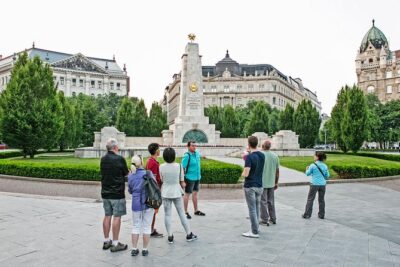
- A monument to the Soviet army
- A statue of President Ronald Reagan
- The entrance to a secret atomic shelter
The combination is unusual. It places American power, Soviet military presence, anti-communist symbolism, and the threat of nuclear war within a short walk. Rather than treating the Cold War as something distant and abstract, the tour shows how it shaped Budapest’s public spaces.
The atomic shelter entrance adds a particularly striking detail. You do not visit an underground shelter as part of the described route, but the entrance signals the fear that sat beneath daily life during the Cold War. The Reagan statue, meanwhile, offers a later American response to the Soviet presence and gives the guide a chance to explain how the political meaning of the square changed after communism.
I find this one of the stronger parts of the itinerary because several historical layers remain visible at once. It is also a good place to ask questions. If you want more than dates and names, ask your guide how these symbols were viewed before and after 1989.
The 1970s housing estates and Goulash Communism
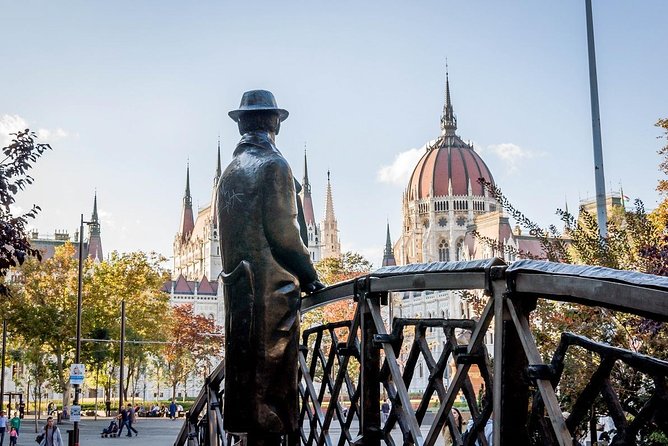
The route then uses the metro to reach one of the 1970s housing estates at the edge of central Budapest. These apartment blocks can look gray and plain today, but the guide explains why they once represented progress for many young Hungarian families.
Older Budapest buildings often lacked the modern conveniences that people now take for granted. Being awarded an apartment in a new housing estate could mean access to an elevator and better household facilities. For a family moving from an older construction, a concrete block was not necessarily a symbol of hardship. It could represent comfort, stability, and a higher standard of living.
This is where the idea of Goulash Communism becomes easier to understand. The system offered limited personal freedoms and a more comfortable daily life than the harshest Stalinist years, but those freedoms came with clear limits. Political obedience remained expected, and major decisions stayed in the hands of the one-party state.
I like this stop because it avoids a simple good-versus-bad story. Communist rule brought censorship, surveillance, and political control, but it also produced housing and social improvements that people experienced in practical ways. You see why some Hungarians remember the era with mixed feelings rather than a single emotion.
The housing estate is also the tour’s least obviously scenic section. If you prefer grand architecture and famous landmarks, this stop may feel ordinary. That is precisely its value, though. It focuses on how the system affected homes, families, and routines rather than only leaders and dramatic events.
More walking tours in Budapest:
- Budapest: Buda Castle Walk with Saint Stephen’s Hall
★ 4.5 · 3,012 reviews - Big Bus Budapest Hop-On Hop-Off Bus and Walking Tour
★ 3.5 · 2,206 reviews - Budapest: Buda Castle District Walking Tour
★ 4.6 · 2,108 reviews - Budapest City Landmarks Walking Tour in 2 Hours
★ 5.0 · 2,048 reviews
Puskás Stadium and Socialist Realist sculpture
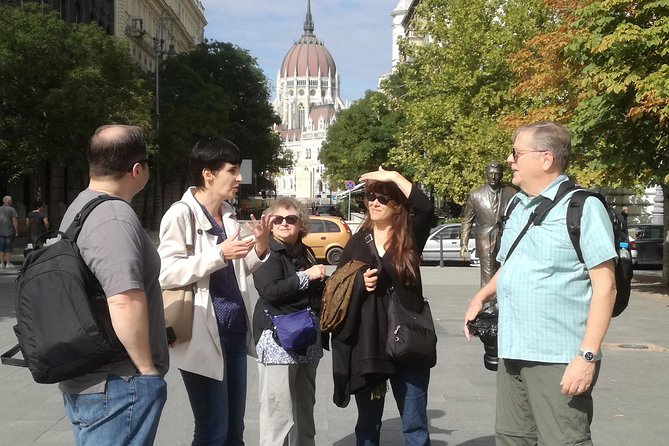
Near the former People’s Stadium, now Puskás Stadium, you see one of Budapest’s better collections of Socialist Realist statues. The figures depict heroic workers, soldiers, and intellectuals, often posed as if they are directing society toward a bright future.
These statues were designed to communicate a political message. The ideal citizen was strong, productive, educated, and loyal to the state. The artwork did not simply decorate public space. It helped present the official version of society and its supposed destination.
The stadium site adds another layer because large sports venues were useful for political gatherings, public ceremonies, and mass demonstrations. It was also a place where the state could display physical strength and collective unity.
The statues are worth seeing even if you do not usually seek out public art. They are direct, imposing, and often unintentionally revealing. A good guide can help you notice the poses, clothing, gestures, and groups represented, then explain what was left out of this idealized picture of Hungarian life.
A trolley ride along the May Day parade route
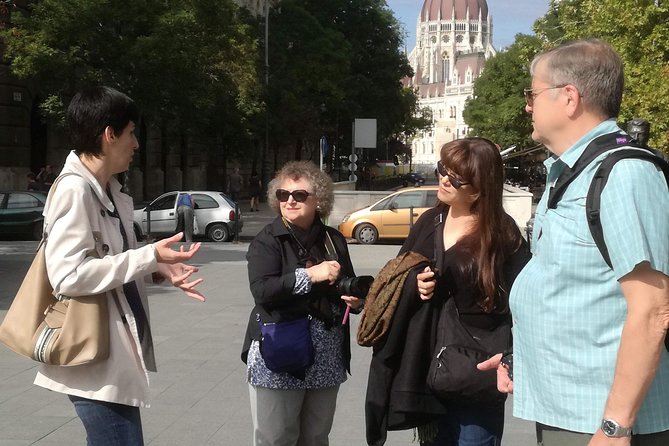
A short ride on one of Stalin’s trolley buses takes you toward Dózsa György Street. The vehicle itself helps keep the focus on the physical experience of communist Budapest, while the broad boulevard recalls the May Day parades once held there.
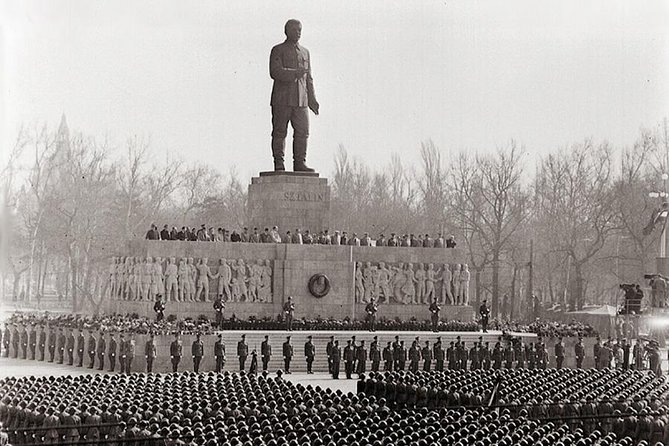
Your guide uses an iPad and old photographs to compare the present street with its appearance during Stalin’s rule. This visual contrast is one of the tour’s most useful tools. You can look at the same urban space in two time periods and see how political power shaped the city’s appearance.
May Day parades were not casual festivals. They were public displays of loyalty, labor, and state control. Workers and organizations were expected to appear in an ordered procession, presenting unity even when private opinions were more complicated.
The old images also help with a problem common to city history tours: places can look too normal today. A boulevard, stadium, or square may offer few visible clues about what happened there. Comparing past and present gives the guide a way to make the vanished political setting easier to picture.
House of Terror and the memory of repression
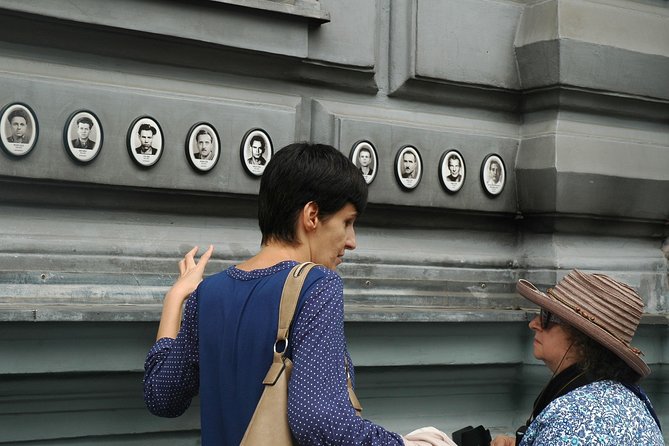
The final major stop is the House of Terror on Andrássy Avenue, housed in the former headquarters of the secret services. The museum commemorates crimes committed under both communist and fascist rule, with a particular focus on the Stalinist period.
The tour does not include admission to the museum, so you should think of this as an exterior stop and a chance to discuss the building’s role. In front of it is a slab of the Berlin Wall, a small but powerful reminder that the division between East and West was once a physical reality.
This ending shifts the mood. Earlier stops explain housing, transport, public art, and political symbolism. The House of Terror brings the discussion back to imprisonment, fear, and state violence. It also helps explain why the modest freedoms of Goulash Communism cannot be separated from the repression that came before and continued in less visible forms.
If you want to visit the museum inside, ask your guide about timing before the tour begins. The listed experience is a three-hour walking tour, and museum entry is not included.
How much value do you get for $123?
At $123 per person, this is not a low-cost city walk. The price makes the most sense for a private tour or a small group, especially if you value a specialist guide and the ability to ask questions along the way.
You are paying for more than a route between landmarks. The guide is expected to have a background as a professor, doctoral student, historian, journalist, art critic, or published author. That level of preparation can turn a plain housing block or a statue into a useful explanation of how the system worked.
The value depends on your starting knowledge. If you know little about Hungary between the end of World War II and 1989, the tour offers a clear structure and a useful introduction. If you already understand the 1956 revolution, the Kádár era, and the transition to democracy, you may find parts of the discussion familiar.
One rating of the experience came from someone who felt the guide stayed too close to basic information and did not add enough about daily life or the end of communism. That is a fair caution. Budapest’s communist period was more evolutionary than openly revolutionary after 1956, so the story may feel less dramatic than similar tours in Prague or Berlin.
The strongest way to get value is to arrive with a few questions. Ask about ordinary work and home life, how Goulash Communism differed from Stalinism, and how Hungary’s gradual changes led toward democracy. A focused conversation can make a major difference on a small-group tour.
Who should book this Budapest communist tour?
I would recommend it to anyone who wants to understand Budapest beyond its imperial buildings and river views. It suits history-minded visitors, students, and people who want to connect Cold War politics with real streets and homes.
It is especially useful for a first visit to Budapest if you have not studied Hungarian history. The route gives you a framework for later visits to the House of Terror, Parliament, or other museums and memorials.
You should think twice if you want a fast-paced sightseeing tour filled with grand interiors. Several stops involve ordinary streets, apartment blocks, transport rides, and public sculpture. That may feel less polished than a standard city highlights tour, but it is also what gives the experience its purpose.
The three-hour duration is long enough to cover several districts without taking up an entire day. Expect walking, metro and trolley rides, and a fair amount of discussion. The October experience was described as interesting but tiring after the walking and information, so comfortable shoes and attention to the pace are sensible.
My verdict on the Communist Budapest Walking Tour
Book this tour if you want the political story of Budapest connected to daily life. The best moments come from the links between Bem József Square and the 1956 uprising, the housing estates and family comfort, and the public statues and parade routes used to promote communist ideals.
The tour is less compelling for someone already well read on Hungary after 1968. In that case, ask in advance how much depth the guide can offer on the transition to democracy and ordinary life. For everyone else, the specialist guide, period photographs, public transport, and small-group format make this a useful way to understand the city’s most difficult decades.
FAQ
How long does the Communist Budapest Walking Tour last?
The tour lasts three hours.
Where does the tour begin?
It begins at Bambi Eszpresszó, Frankel Leó út 2/4, 1027 Budapest.
What language is the tour offered in?
The tour is offered in English.
Are metro and tram tickets included?
No. Tram and metro tickets are not included in the tour price.
Is the tour private or shared?
Private and small-group options are available.
Who leads the tour?
Guides include professors, doctoral students, historians, journalists, art critics, and published authors.
Recently added around Budapest
- Budapest: Private Walking Tour with a Local Guide★ 3.6 · 6 reviews
- From Budapest: Guided Tour of Eger with Wine Tasting★ 4.5 · 6 reviews
- Budapest: City Bike Tour with Coffee Stop★ 5.0 · 37 reviews
- Budapest: Danube River Views Bike Ride★ 4.8 · 23 reviews
- Budapest: Vacation Photographer to collect great memories★ 5.0 · 49 reviews
- Walk to recent and aged spiritual sanctuaries near Budapest★ 5.0 · 5 reviews
- Trash Art Museum: Hungary’s First Scrap Metal Exhibition★ 4.3 · 72 reviews
- Budapest: Multilingual Highlights Tour★ 4.8 · 89 reviews
Communist History Tours, compared.
Communist History Tour with House of Terror Option
Read our review →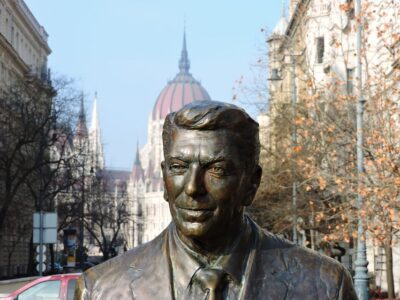
3-Hour Walking Tour About Communism (Small Group)
Read our review →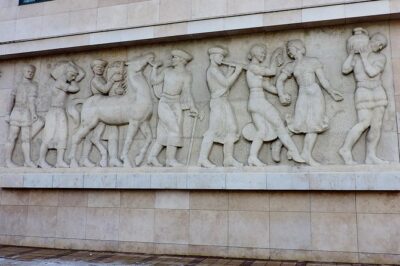
Lives of Hungarians Under Communist and Capitalist system
Read our review →
Private Budapest Hammer & Sickle Communist Times Tour
Read our review →
Browse the lists this tour appears in